The NeMo.bil project celebrated its successful completion

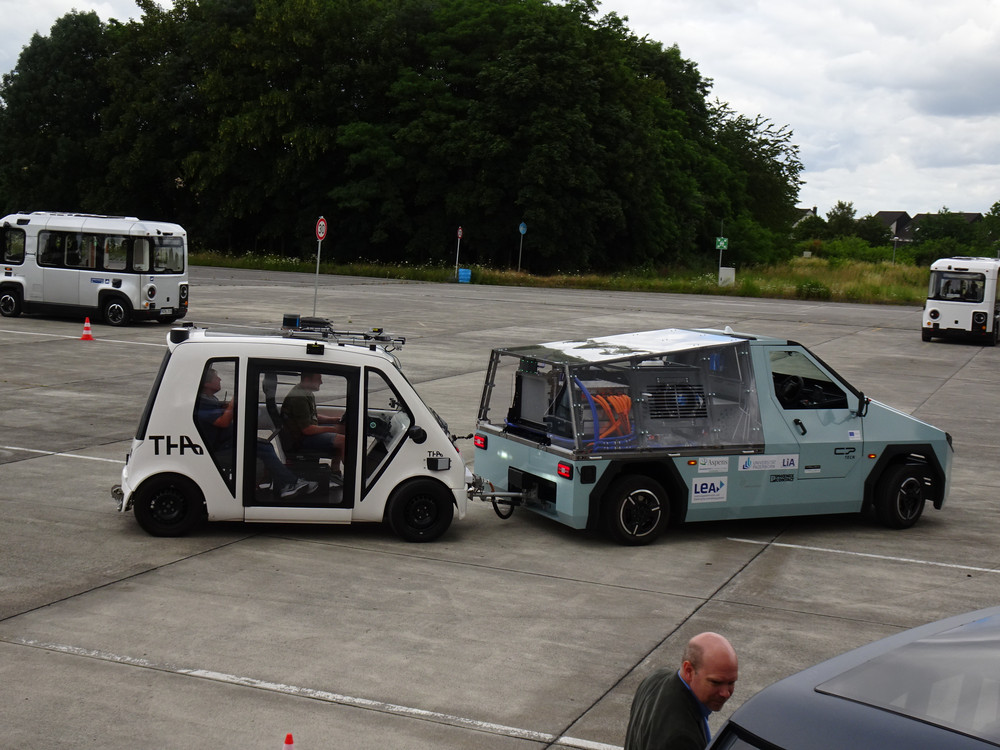
The NeMo.bil project took an innovative approach using two types of vehicles designed to work together. Swarms of smaller autonomous vehicles (Cabs) handle the first and last miles. On longer routes, they join together to form a convoy pulled by a larger vehicle (Pro). This system is ideally suited to enabling resource-efficient, personalized public transportation, particularly in rural areas.
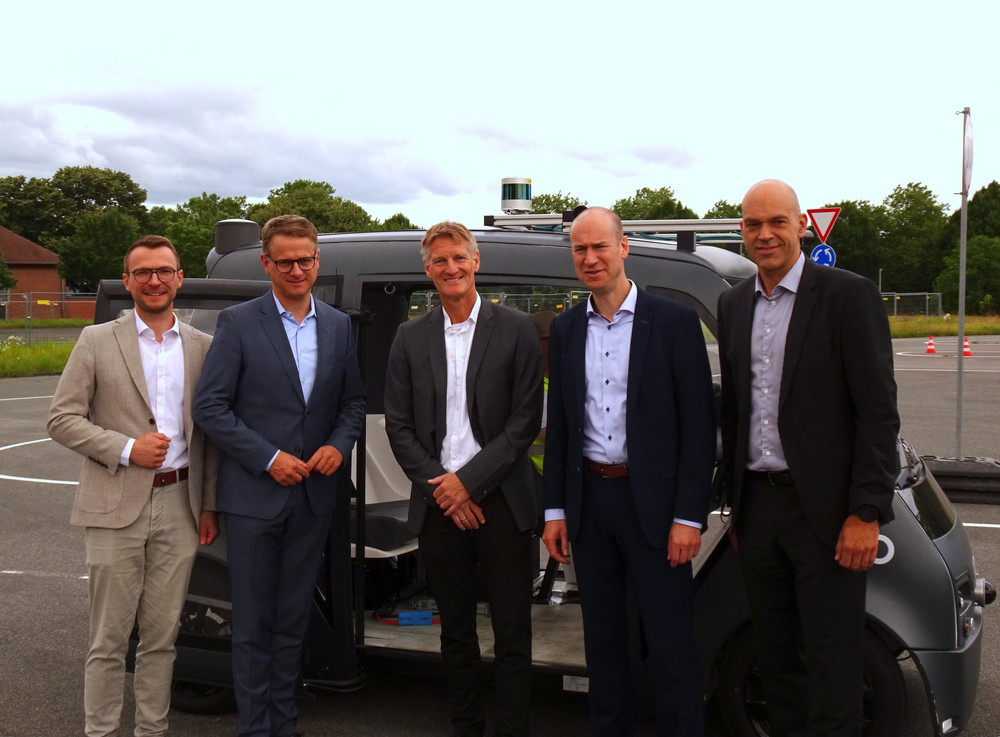
At the closing event at the Zukunftsquartier in Paderborn, guests were able to experience the project’s results in their entirety for the first time. Stakeholders from politics, business, academia, and government gained insights into the vehicles, digital applications, and technical systems that were developed. Discussions surrounding the trade exhibition and during test drives demonstrated how the individual components of the mobility concept work together and what potential they hold for the mobility of the future.
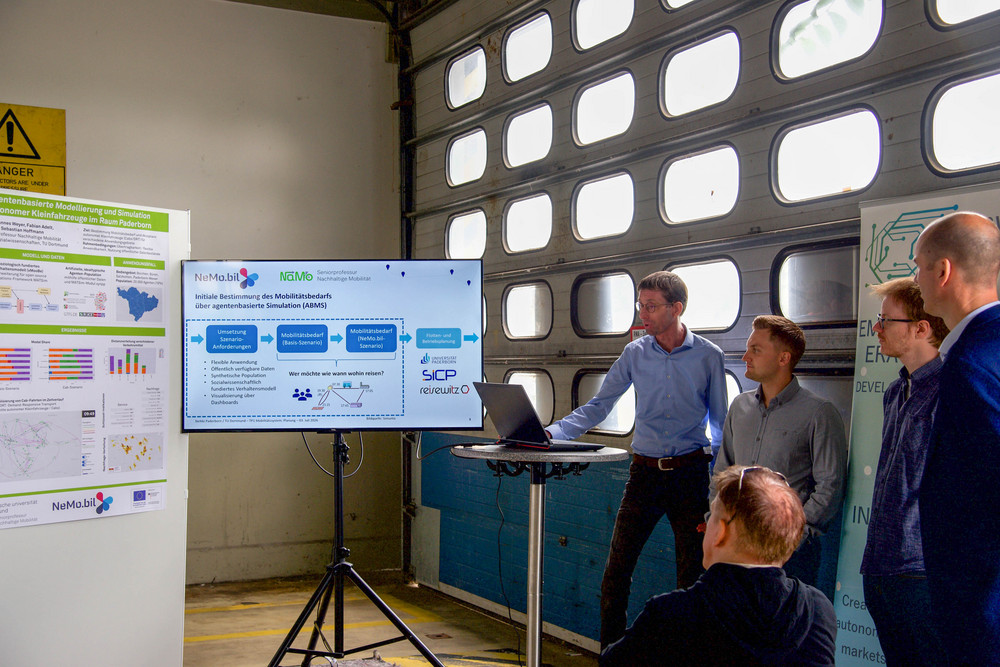
As part of the accompanying exhibition, Fabian Adelt and Sebastian Hoffmann presented results from agent-based traffic simulations conducted as part of the project to determine acceptance levels and mobility needs. These findings show that autonomous on-demand cabs would be preferred by various mobility segments (e.g., environmentally conscious individuals) when choosing a mode of transportation. At the same time, unintended side effects may arise, as the shift from cycling and walking to cabs could also lead to increased road traffic.
The simulations were conducted using the open-source framework MATSim and are based on various publicly available mobility and map data. The generated mobility demands are being further utilized by the project partner Software Innovation Lab (SI-Lab) at the University of Paderborn for convoy and fleet optimization.
Although the project period ends with the successful completion of NeMo.bil, NeMo e.V. will continue to further develop the solutions created. The light vehicles developed in the project for the first and last mile form an important foundation for future swarm mobility concepts. The senior professorship is also involved in several follow-up proposals in which autonomous vehicles are deployed, tested, evaluated, and further optimized.